For most independent professionals, marketing is planned the way New Year's resolutions are made: hurriedly, optimistically, and in January, at the very moment the year's substantive work begins to crowd it out. By February the plan has been postponed, by spring it has been forgotten, and by the following November the identical conversation begins again. The firms that escape this cycle tend to share one discipline. They make their marketing decisions in late autumn, when sufficient time remains to construct something before the new year makes its demands.
This article offers a practical framework for that November decision: how to diagnose what your marketing genuinely requires, what a fully managed system should include at each level, which questions to ask any prospective provider before committing, and why, in our model, the Exclusive Territory is the decision that must precede all the others.
Why November is the right month
November possesses several structural advantages as a planning month. Budgets for the coming year are typically being established, which means that a decision made now can be funded deliberately rather than improvised later. For CPAs and bookkeepers, November represents the last relatively tranquil window before the filing season makes new commitments nearly impossible. For custom builders and remodelers, the late-year deceleration in many regions is the natural opportunity to populate the spring pipeline. For planners, coaches, consultants, designers, and independent practitioners, it is the month when the preceding year's results remain recent enough to evaluate honestly.
Preparation time is also a straightforward factor. A website must be constructed, content must be planned, and automated sequences must be written and approved before any of them produce results. A system commissioned in November can be operational when the new year begins, whereas a system commissioned in January will spend the entire first quarter being assembled.
Begin with a diagnosis, not a budget
The most common planning error is to begin with a dollar figure and then ask what it will purchase. A considerably more useful starting point is to identify which of three distinct problems the practice actually has, because each requires a fundamentally different solution.
The first problem is that prospects cannot find you, or that what they discover does not reflect the quality of your work: the site is outdated, sluggish, or generic, and it quietly argues against every referral you receive. The remedy is foundational, namely a professionally built, maintained, and secured website designed to be discovered and to make you appear exactly as credible as you are.
The second problem is that prospects can locate you but do not yet know you. Your credibility is genuine, but nothing in your public presence demonstrates ongoing expertise, so the remedy involves visibility and authority: published articles, consistent social presence, and a monthly campaign calendar that keeps your name in front of the appropriate audience.
The third problem is that people know you exist, but nothing happens next, because inquiries go quiet, interested visitors depart without a trace, and the relationship terminates at first contact. The remedy is cultivation. It encompasses lead magnets, automated nurture sequences, a newsletter, and direct booking.
Be candid with yourself about which problem is the binding constraint. If insufficient numbers of people know you exist, adding a nurture system will accomplish little, because there is no one to nurture; conversely, if people know you exist and nothing happens next, additional visibility will not resolve the difficulty. The diagnosis determines the solution, and a provider who sells you the wrong one is not doing you a favor.
What "fully managed" should actually mean
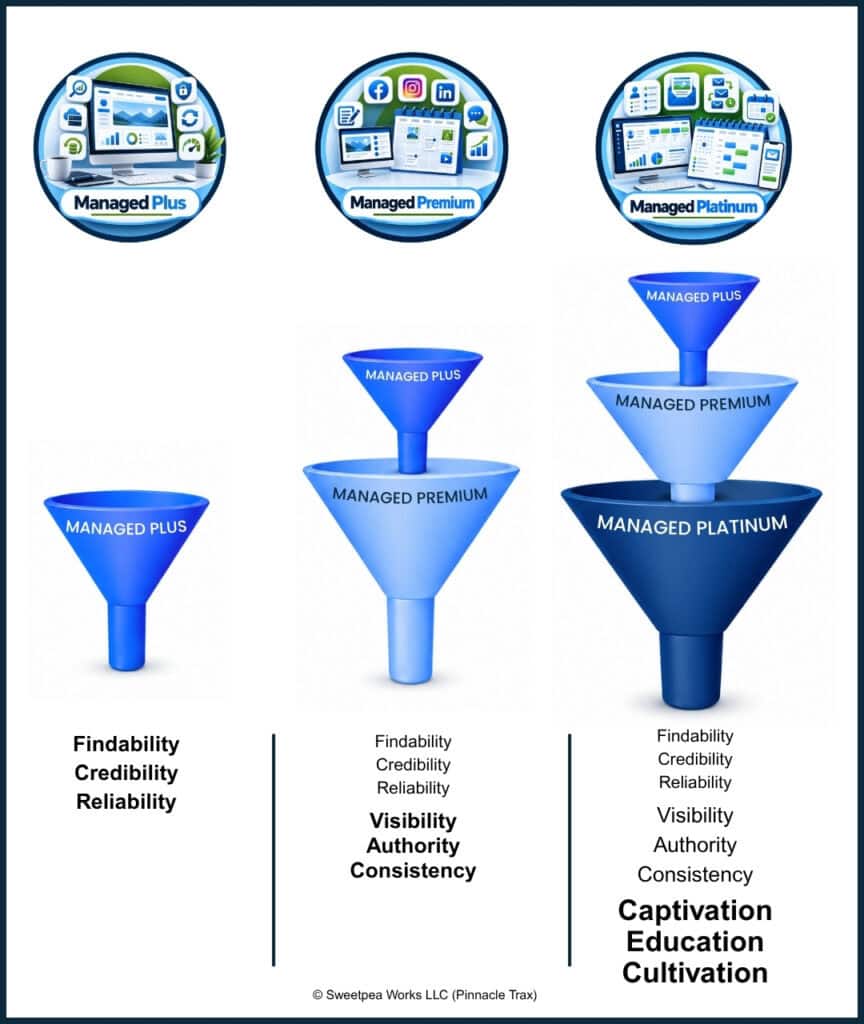
The phrase "done for you" has been stretched to describe services that deliver a content calendar and a login and then leave the actual work to the client. A fully managed system should mean that your responsibility is limited to approval: you review, you approve, and the work proceeds. Measured against that standard, here is what each level of Pinnacle Trax includes.
Managed Plus addresses findability, credibility, and reliability. It includes a custom website built for your specific profession, continuous maintenance and security, daily backups, performance optimization, and on-page search fundamentals, and it constitutes the foundation upon which every subsequent layer depends.
Managed Premium addresses visibility, authority, and consistency. In addition to the foundation, it includes a monthly campaign calendar delivered in advance, professionally designed and published social posts across the major networks, and two articles each month written for your profession and published to your site. Managed Premium is also the level at which the Exclusive Territory begins.
Managed Platinum addresses captivation, education, and cultivation, adding a contact management system connected to every form on your site, automated nurture sequences, a monthly branded newsletter, a new lead magnet each month, short-form video, direct online booking, and the most expansive territory available.
The available evidence supports this sequence. The 2026 Kitces Report, which surveyed 506 financial advisors, found that search optimization was among the most efficient tactics measured, requiring approximately 45 cents of marketing expenditure per dollar of new revenue, yet only 32 percent of practices employ it. Social media, by contrast, was the least efficient tactic overall, at approximately $4.88 per dollar, although the report found that completely outsourced social media performed dramatically better than the self-managed version. In other words, the foundation matters more than most firms assume, and the activities owners most frequently attempt themselves are among the least efficient when conducted that way.
Questions to ask any provider before you commit
Whomever you ultimately select for next year, several questions reliably distinguish a genuine partner from a vendor selling activity. Ask who actually performs the work each month, and whether the same people will still be performing it next year. Ask precisely what you will approve, and what happens if you are temporarily too occupied to review it. Ask what you retain if you leave. In our case, the answer is your domain, your content, and your contacts, while the underlying platform is not transferable, a deliberate trade that makes a fully managed system affordable for a small practice. Ask what the provider will not do, because a provider unwilling to articulate its limitations is unlikely to respect yours. Finally, ask whether the provider will also work with your direct competitor down the street, a question that deserves its own section.
Why the Exclusive Territory is reserved first
Most marketing providers will serve any number of firms in the same profession and the same market, with a predictable consequence: competing practices receive similar strategies, similar content, and similar campaigns, each effectively paying to neutralize the other.
Pinnacle Trax operates differently. Beginning at Managed Premium, each client receives an Exclusive Territory, meaning one client per profession, per territory. Each territory is defined with you during Discovery, based on where your clients actually come from, and Managed Platinum expands it. Once a territory is reserved for a profession, it is not offered to that client's competitors.
This is why territory, rather than budget, constitutes the first decision. Territories are reserved first come, first served, without waitlists or informal holds, and the resulting scarcity is not a promotional device but a structural feature of the model, because each combination of profession and territory can be filled exactly once. A firm that decides in November and a competitor that decides in February are therefore not making the same decision a few months apart; one of them is reserving a territory, and the other is discovering that it has already been reserved.
A November planning checklist
Before the year concludes, dedicate an hour to five deliberate steps. First, quantify last year's lost opportunities, including unanswered inquiries, referrals that never scheduled appointments, and proposals that stalled. Second, identify your binding problem: not found, found but not known, or known but not converting. Third, evaluate your website as a referred prospect would, on a phone, in less than a minute. Fourth, determine what you are genuinely willing to continue doing yourself and what you would rather approve than produce. Fifth, ask whether your profession's territory remains available in your market.
The next step
If you are a credentialed professional without anyone on staff whose responsibility is marketing, November is the month to determine what next year will look like. Sweetpea Works LLC builds and operates Pinnacle Trax for precisely that professional, and the first conversation always begins with an honest diagnosis and a territory check. Book A Consultation at pinnacletrax.com.
Sources
- Financial Planning, "Kitces research pegs the winners and losers in marketing ROI" (September 2026)
- Pinnacle Trax, tier and territory descriptions
