Nearly every credentialed professional recognizes some version of this story. A prospect completes the contact form on a weekday afternoon while you are with a client, walking a job site, or immersed in a complicated return. By the time you surface, two days have elapsed. You call, leave a voicemail, and send a courteous email, yet nothing comes back. Weeks later you learn that the family, the homeowner, or the business owner signed with someone else: not someone more qualified, but simply someone sooner.
That outcome represents a failure not of expertise but of timing, and timing, unlike talent, is fundamentally a systems problem. This article examines what the research reveals about how quickly a prospect's interest dissipates, why small expertise-driven firms are structurally vulnerable to what we call the follow-up gap, and what an automated nurture system accomplishes, and deliberately does not attempt, in closing it.
Interest has a half-life
The most frequently cited evidence on response speed comes from research published in Harvard Business Review by James Oldroyd, Kristina McElheran, and David Elkington, who audited 2,241 U.S. companies by submitting web inquiries and measuring how long each organization took to reply. Only 37 percent responded within an hour. Among the companies that answered within 30 days, the average response required 42 hours, and 23 percent never responded at all. A companion analysis of approximately 1.25 million inquiries found that firms initiating contact within an hour were nearly seven times as likely to qualify the prospect as firms that waited even one additional hour, and more than 60 times as likely as firms that delayed a day or longer.
The study is more than a decade old, and its subjects were larger organizations with dedicated sales departments. Yet both characteristics paradoxically strengthen its relevance to a solo planner or a two-person design studio. If organizations with specialized staff left nearly a quarter of their inquiries unanswered, an independent professional who serves simultaneously as the firm's only salesperson, service provider, and administrator confronts considerably worse odds. Nothing about the intervening years suggests that prospective clients have become more patient. If anything, the proliferation of alternatives available at a single tap has made them less so.
Referrals no longer conclude the evaluation
Many expertise-driven firms assume that the follow-up gap applies to strangers rather than to referrals, reasoning that a referred prospect has effectively already decided. The available evidence suggests otherwise. In a survey of 1,028 purchasers of professional services, Hinge Research Institute found that over 99 percent investigate a firm before choosing it and over 80 percent visit its website. A referral earns consideration; it does not conclude the decision.
The financial planning profession supplies particularly instructive data, because its practitioners are surveying themselves rather than being surveyed by organizations with something to sell. The 2026 Kitces Report, drawn from 506 advisors at U.S. practices, found that high-growth firms derive only about a third of their new-client revenue from referrals, whereas their slower-growing peers depend on referrals for roughly 80 percent. The practices pulling ahead have not abandoned referrals. Rather, they have constructed the systems that capture everyone else, including the referred prospect who investigated them, hesitated, and needed a compelling reason to take the next step.
Consumer behavior points in the same direction. BrightLocal's 2026 survey of 1,002 U.S. adults found that 45 percent now consult artificial intelligence tools for local recommendations, an extraordinary increase from 6 percent a year earlier. Prospects, in other words, are researching more extensively and comparing more alternatives before committing. Consequently, the interval between initial interest and final selection now contains more competitors than ever before.

Why small firms are structurally exposed
The follow-up gap rarely reflects a deficiency of diligence. Instead, it emerges from the very architecture of a small, expertise-driven practice, in which the professional's most valuable work and the firm's response window compete for identical hours. The independent life insurance agent or retirement planner spends the most productive hours of the week in appointments, precisely when new inquiries tend to arrive. The custom builder or high-end remodeler is on a job site, where answering correspondence is neither safe nor practical. The CPA or bookkeeper is approaching the season when initiating new conversations becomes nearly impossible. The established coach or consultant is delivering the engagements that sustain the practice financially. The architect or interior designer is occupied with client presentations, site visits, and installations. The direct primary care physician, naturopathic doctor, or chiropractor is with patients, which is, after all, the entire purpose of the practice model that professional deliberately chose.
A 2025 Local Impact survey of 400 local businesses found that the owner functions as the primary marketing person in 59 percent of them, whereas an outside agency manages marketing in just 8 percent. In most small firms, therefore, the individual responsible for following up is precisely the individual least able to do so promptly. The gap is less a character flaw than an arithmetical inevitability.
What an automated nurture system actually does
A nurture system is not a substitute for the professional; it is a substitute for the delay, and when properly designed, it performs four distinct functions.
First, it acknowledges every inquiry immediately. The moment a prospect submits a form, requests a guide, or asks for a consultation, the system dispatches a confirmation that is specific, warm, and composed in the professional's own voice. The prospect knows the inquiry arrived, understands what happens next, and never wonders whether anyone is paying attention.
Second, it converts anonymous interest into a named relationship. Every form on the website feeds a single, organized contact list, categorized according to what each individual inquired about. A homeowner who requested a remodeling guide and a retiree who asked about income planning receive different communications, because they did not ask the same question.
Third, it educates prospects progressively. A sequence of messages, distributed across days and weeks, answers the questions that prospects in a particular profession reliably ask before they are prepared to commit. This function matters most in professions characterized by long, considered decisions, where the prospect who is not ready today may be ready in four months, provided someone has remained consistently present in the meantime.
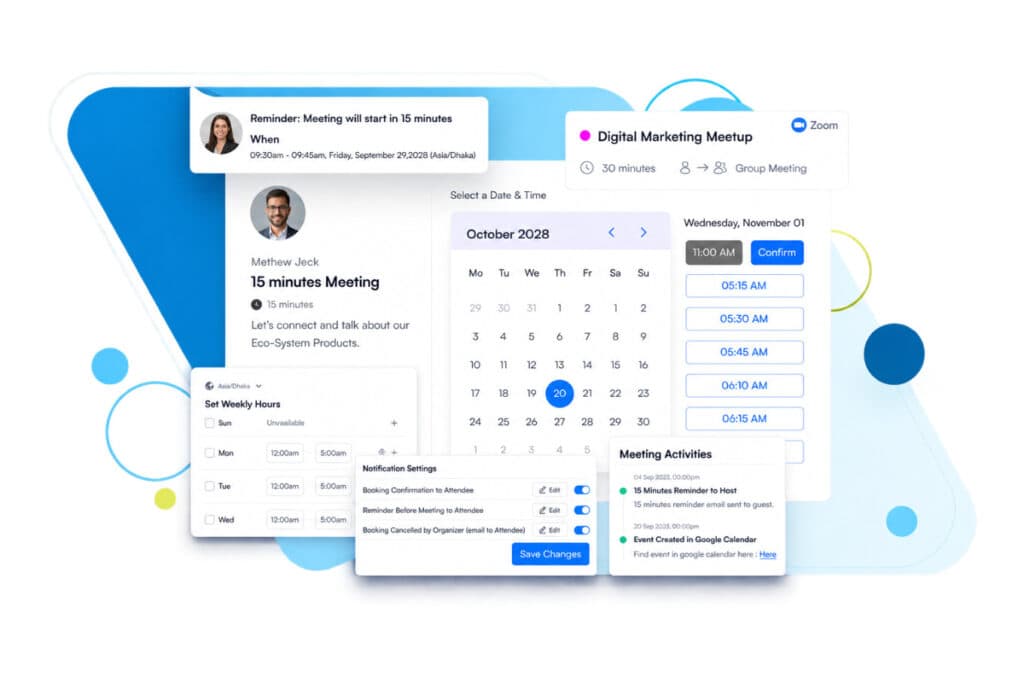
Fourth, it makes the next step effortless. When a prospect is finally ready, direct online booking eliminates the protracted telephone exchanges that so often extinguish momentum.
Equally important is what such a system cannot do. It cannot close the deal, offer professional advice, or replace the judgment for which prospects are ultimately paying. Its purpose is to hold the door open until the professional can walk through it. The professional's responsibility remains exactly what it always was: make the sale, close the deal.
The lead magnet: a front door for the not-yet-ready
Most website visitors are not prepared to book a consultation on their initial visit, and requesting that commitment prematurely is how firms forfeit the majority of their genuinely interested traffic. A lead magnet, such as a practical checklist, a planning guide, or a concise reference document, gives the not-yet-ready prospect a legitimate reason to exchange a name and email address for something genuinely useful. The visitor thereby becomes a contact, the contact enters a nurture sequence, and the firm acquires the one asset that no search engine or social platform can throttle: a list of individuals who explicitly asked to hear from it.
This approach is also the responsible one. Opt-in lead magnets respect the regulations governing commercial email, including the federal CAN-SPAM Act's requirements for an unsubscribe mechanism and a physical address, in a manner that purchased lists and indiscriminate cold messages do not.
Consistency outperforms intensity
The final component is the least glamorous and the most durable: a monthly newsletter, distributed to everyone on the list, that keeps the professional present between referrals. Prospects in professions characterized by considered decisions rarely act on the first message. They act when a life event, a construction project, or an approaching deadline makes the decision urgent, and they tend to contact whoever has been consistently and unobtrusively useful in the interim. A firm that publishes intermittently, in bursts of enthusiasm followed by months of silence, surrenders that position to a competitor whose only advantage was appearing every month.
Closing the gap before the new year
November is an unusually opportune month to address the follow-up gap, because the problem is most visible in retrospect. Review the past year and count the inquiries that went quiet after your first reply, the referrals who never scheduled an appointment, and the website visitors who departed without leaving any trace. Each represents a prospect who was sufficiently interested to act and was subsequently lost in the interval.
Pinnacle Trax was designed for precisely this problem. At the Managed Platinum level, Sweetpea Works LLC constructs and operates the entire cultivation layer on your behalf. That layer includes lead magnets, automated nurture sequences, a monthly newsletter, and direct booking, all written specifically for your profession and approved by you before anything is sent. If the follow-up gap sounds familiar, we would welcome a conversation about whether this approach is appropriate for your practice. Book A Consultation at pntx.pinnacletrax.com.
Sources
- Oldroyd, McElheran, and Elkington, "The Short Life of Online Sales Leads," Harvard Business Review, 2011 (BYU ScholarsArchive record)
- SmartCompany summary of the Harvard Business Review audit findings (2,241 companies; 37 percent within an hour; 42-hour average; 23 percent never responded; 7x and 60x)
- Hinge Research Institute, "How Professional Services Buyers Check You Out" (2014)
- Financial Planning, "Kitces research pegs the winners and losers in marketing ROI" (September 2026)
- BrightLocal, Local Consumer Review Survey 2026
- LocalImpact, State of Small Business Marketing (2025)
